
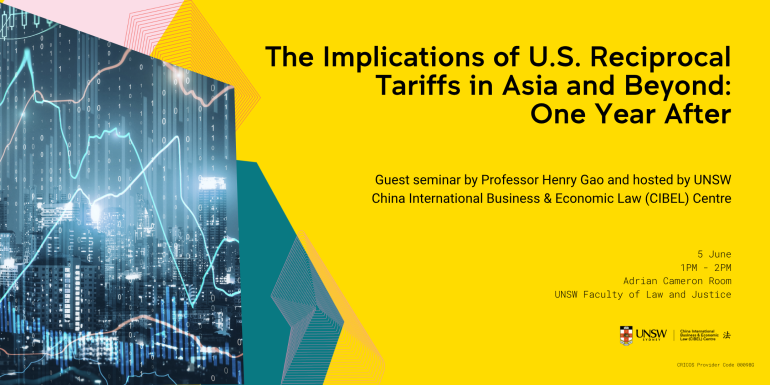
On April 2, 2025, the United States stunned the global trading system by announcing sweeping “reciprocal tariffs” on all trading partners. The impact was felt most acutely in Asia, where several export-oriented economies faced some of the steepest tariff hikes. While many commentators were quick to denounce the so-called “Liberation Day tariffs,” much of the early reaction overlooked the deeper strategic logic underpinning the policy.
Over the past year, however, Prof. Henry Gao has stood out as one of the few analysts who not only identified the strategic intent behind these tariffs from the outset, but also anticipated the trajectory of subsequent bilateral negotiations and the substantive content of the resulting agreements. As events have unfolded, his analysis has proven notably prescient—effectively mapping the direction of policy missed by most observers.
In this seminar titled The Implications of U.S. Reciprocal Tariffs in Asia and Beyond: One Year After, Prof. Gao will revisit the Liberation Day tariffs one year on, unpacking both their original rationale and their real-world consequences. Drawing on his recent work in the American Journal of International Law and the World Trade Review (with Prof. Weihuan Zhou), he will examine the political-economic logic driving the policy, analyze responses from key actors, especially China, and explore how the emerging bilateral deals are reshaping global trade governance in ways that remain under-appreciated.
Register
About the speaker:
Henry Gao is Professor of Law at Singapore Management University and Senior Fellow at CIGI. With law degrees from three continents, he started his career as the first Chinese lawyer at the WTO Secretariat. He has been an advisor on trade issues for many national governments as well as the WTO, UN, World Bank, ADB, APEC, ASEAN and the World Economic Forum. Widely published on China and WTO and digital trade issues, he sits on the Advisory Board of the WTO Chairs Program and the Executive Council of the American Society of International Law, as well as the editorial boards of American Journal of International Law and Journal of International Economic Law.