
1 December 2025
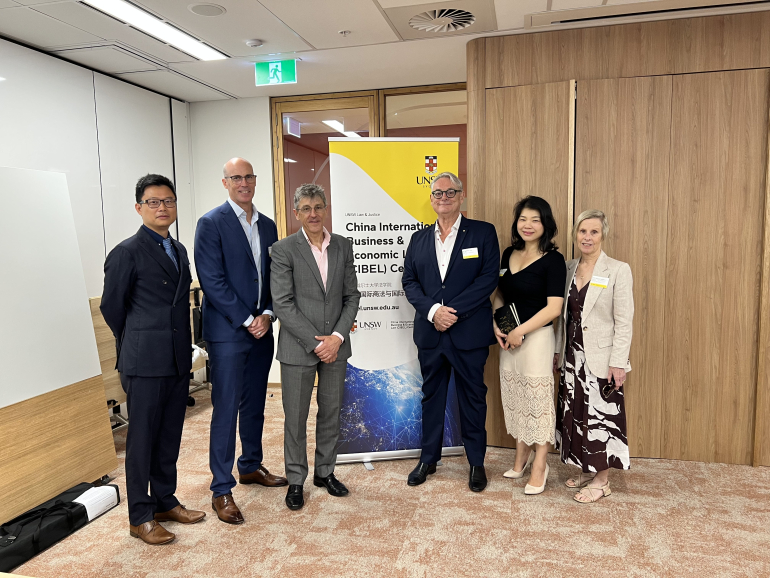
The 2025 CIBEL Global Network Conference, held on 25-26 November at the UNSW CBD Campus, brought together researchers, policymakers and business leaders for one-and-a-half days of discussions focusing on ‘Australia in a Changing Global Economic Order’.
The 2025 CIBEL Global Network Conference was convened at a pivotal moment for the global economy. Global change and geopolitical uncertainty are prompting renewed debate about the international economic order and Australia’s place within it. Post-COVID realities, the reduced role of the WTO, and the resurgence of industrial policy, including heightened scrutiny of foreign investment, are changing the momentum of international relations and policy development. Against this backdrop, across five panels and a keynote address, speakers engaged with cutting-edge issues faced by governments and the world economy, including AI governance, international trade law, international investment law, competition law, and the way forward.
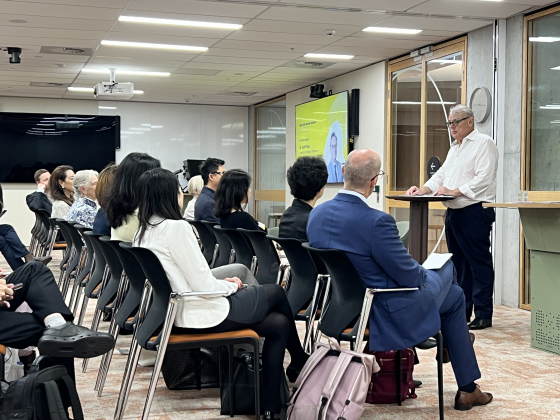
Keynote speaker at the Conference was Geoff Raby AO, who discussed Australia’s “strategic choices” in what he described as a “fragmenting” global order with CIBEL member and Professor Mimi Zou (UNSW Law & Justice). Dr Raby highlighted the destructive impact of trade policy changes in major economies amid escalating geopolitical shifts and great power competition. He envisaged a new world order and how Australia may respond in ways that advance Australia’s national interest.
Following morning tea, the first panel focused on ‘Digital China in Global Context’ and was also chaired by Professor Zou, featuring contributions from Dr Roger Zhang (Tencent), Professor Wanning Sun (UTS) and A/Prof Marina Zhang (UTS). The panel highlighted the growing tension between technological interdependence and national security concerns, and what this means for Australia’s digital and trade policy settings.
Panel 2 looked at ‘Industry Policy and Competition Law’ with Dr Rhonda Smith (Melbourne University), Professor Chenying Zhang (Tsinghua University) and Scientia Professor Richard Holden (UNSW Business School); the session was chaired by Yan Yu (RBB Economics). Speakers discussed the resurgence of industrial policy in response to supply chain vulnerabilities, climate transition pressures and technological competition.

Concluding day one of the Conference was Panel 3, which tackled the pressing issue of ‘Navigating a Chaotic Global Trading System’. Chaired by Professor Weihuan Zhou (Co-Director of CIBEL Centre, UNSW Law & Justice), Catherine Raper (DFAT), Professor Henry Gao (SMU) and Professor James Laurenceson (UTS) reflected on the structural challenges confronting the multilateral trading system.
Day two began with panel 4, ‘Foreign Investment in a Geopolitical Context’. Chaired by A/Prof Kun Fan (CIBEL Member, UNSW Law & Justice), Professor Vivienne Bath (USYD), A/Prof Jonathan Bonnitcha (CIBEL Member, UNSW Law & Justice) and Dr Lu Wang (CIBEL Member, UNSW Law & Justice) examined how geopolitical tensions are reshaping foreing investment governance.
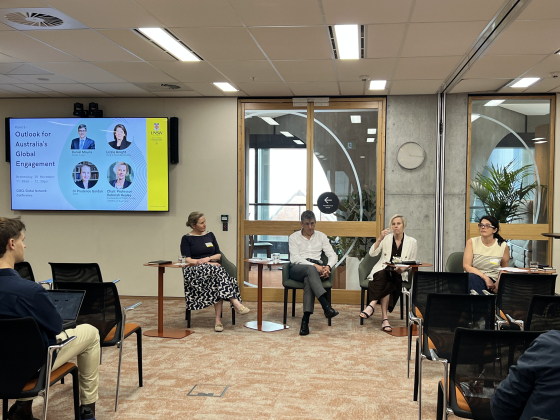
Panel 5, ‘Outlook for Australia’s Global Engagement’ was an appropriate final topic for the event, with Daniel Moulis (Moulis Legal), Lizzie Knight (King & Wood Mallesons), Dr Prudence Gordon (ACITI) joining Deborah Healey (Co-Director of CIBEL Centre, UNSW Law & Justice) in her capacity as chair. The discussion focused on Australia’s positioning as a middle power in a fragmented economic landscape.
At closing, Professor Weihuan Zhou thanked all participants and offered the following remarks:
“The world economy is changing in unprecedented and unpredictable ways. Governments and businesses alike are working hard on their directions and strategies. At this junction, this year’s CIBEL Global Network Conference aims to unpack the complexities, challenges and opportunities in this changing world and implications for stakeholders.
Many have taken action, provocatively, defensively, and/or reactively. But as governments move from cooperation to unilateralism, from global interests to selective engagement and inward-looking policies in creative ways, all of us are navigating in uncharted waters.
Despite all the changes facing us, the world is highly interdependent. That’s a reality. This interdependence can be used to promote shared interests as we experienced in the past decades. However, this interdependence can also be used as a weapon, often in mutually and globally disruptive ways. This is a choice.”
Stay tuned for a future announcement regarding next year’s CIBEL Global Network Conference, returning in 2026 bigger and better than ever before.