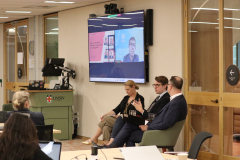
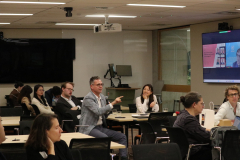
Global trade is at a historical juncture and requires a systematic reimagining. The conference brought together a diverse group of experts and stakeholders to discuss and debate some of the most challenging issues and future directions.
Over two days, the conference examined global trade at a moment of significant change. Strategic competition, security concerns, industrial policy, technology and the transition to a lower-carbon economy are reshaping trade, with decisions in one area increasingly affecting the others.
Discussions explored the growing securitisation of trade and its effects on government policy and business decisions, as well as how companies are responding to geopolitical uncertainty. As competition between major powers intensifies, participants considered the role of middle powers and whether Mark Carney’s vision of “variable geometry” offers a realistic path forward.
Through three sessions on Day 1, we tried our best to Reimagine Global Trade in three core dimensions: the overarching trade and policy landscape, trade and security, and variable geometry.
A diverse range of issues were discussed and debated - from trade flows, tariffs, export controls, and economic coercion to critical minerals and infrastructures, tech competition, reshoring, plurilateral, and new generation economic arrangements.
We heard from a mix of expertise and considered policy and business solutions to real life challenges ahead.
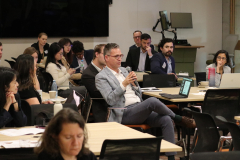
The audience was engaged throughout the day, with lively questions and contributions adding to the conversation.
Panel 1: Global Trade - What has Changed and Why Does it Matter? Featured Prof James Laurenceson (University of Technology Sydney), Patricia Holmes (DFAT), Stefano Moritsch (KPMG) and chaired by Dr Prudence Gordon (ACITI).
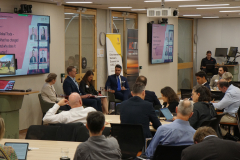
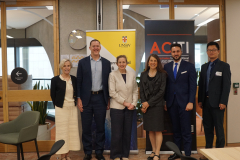
Panel 2: How is Trade Used to Achieve National Security Objectives and is it Effective? featured Simon Lacey (Virtually from Access X), Hayley Channer (USSC, University of Sydney), Prof Lisa Toohey (CIBEL, UNSW) and chaired by Prof Weihuan Zhou (CIBEL, UNSW)
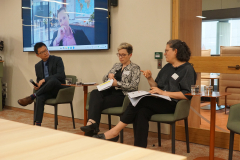
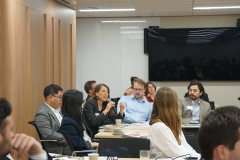
Panel 3: Is Mark Carney’s Vision (for an Intergovernmental System Based On Variable Geometry) realistic? featured Meredith Kolsky Lewis (Buffalo School of Law and Victoria University of Wellington Law School), Prof Markus Wagner (University of Wollongong), Prof Bernard Hoekman (Virtual from European University Institute in Florence) and chaired by Mr Philipp Ivanov (ACITI)
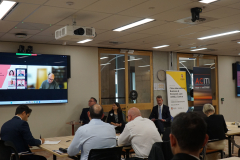
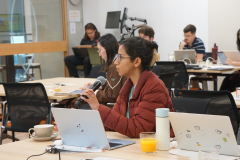
Day 2 carried these discussions into the intersection of trade rules with industrial policies, artificial intelligence, the green transition and risk management. Speakers and participants considered how governments can balance industrial policy goals with liberal trade, how AI might inform trade policy-making, whether great-power competition will derail green trade, and what effective risk management requires in a more uncertain trading environment.
Combining diverse expertise and perspectives, the discussions examined longstanding and emerging challenges, as well as possible responses. The questions raised will remain central to efforts to reimagine the changing global trade order.
Panel 4: Is industrial Policy Antiethical to Open Markets and How can Australia Reconcile Industry Policy Goals with Liberal Trade? featured Louise McGrath (Australian Industry Group), Prof Roy Green (University of Technology Sydney), Prof David Widdowson (Charles Sturt University and WiseTech Academy), Dr John Kunkel (USSC, University of Sydney), Carl Chang (Department of Industry, Science and Resources) and chaired by Professor Ross Buckley (UNSW).
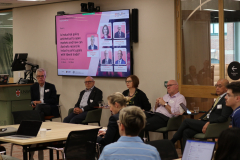
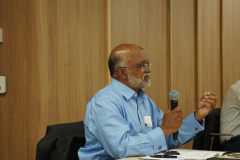
Panel 5: How Will Emerging Technologies such as AI Impact Global Trade and How to Embrace such Technologies in Trade Policymaking? featured Anthony Wan (Clear.ai), A/Prof Han-Wei Liu (Virtual speaker from Singapore Management University), Prof David Widdowson (Charles Sturt University and WiseTech Academy), and chaired by Kun Fan (CIBEL, UNSW).
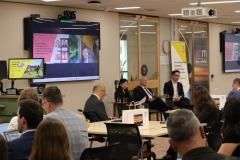
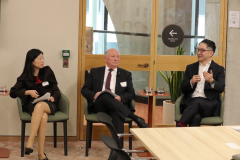
Panel 6: Will great power competition derail green trade? featured Prof Elizabeth Thurbon (UNSW), Joanna Kay (The Superpower Institute), Namali Mackay (Critical Minerals Association Australia), and chaired by Prof Lisa Toohey (CIBEL, UNSW).
Panel 7: Does a New Era of Global Trade Require New Approaches to Risk Management?featured George Riddell (Goyder Ltd), Yann Duval (Virtual attendance from UN ESCAP), Dr Merriden Varrall (Vantage Geopol), and chaired by Stephen Walters (ACITI)